The Default Mode Network (DMN), Salience Network (SN), and Central Executive Network (CEN) are three key large-scale brain networks that interact to govern different aspects of cognition and behavior. Here's an overview of each:
1. Default Mode Network (DMN)
- Function: The DMN is most active when the brain is at rest or focused on internal thoughts, such as daydreaming, self-reflection, and mind-wandering. It is involved in autobiographical memory, theory of mind (understanding others' mental states), and envisioning the future.
- Key Areas: The DMN includes regions such as the medial prefrontal cortex, posterior cingulate cortex (PCC), precuneus, and lateral parietal cortex.
- Role in Disorders: Disruption in the DMN has been linked to psychiatric and neurological conditions such as schizophrenia, and Alzheimer’s disease.
2. Salience Network (SN)
- Function: The SN helps detect and filter important stimuli, whether internal (such as pain or hunger) or external (such as a loud noise). It plays a role in switching between the DMN (internal focus) and the CEN (external focus), enabling the brain to respond to significant changes in the environment.
- Key Areas: The SN is anchored by the anterior insula and the dorsal anterior cingulate cortex (dACC).
- Role in Disorders: Dysfunction in the salience network has been associated with disorder such as frontotemporal dementia, where the ability to appropriately focus on relevant stimuli may be impaired.
3. Central Executive Network (CEN)
- Function: The CEN is responsible for high-level cognitive functions like working memory, decision-making, problem-solving, and maintaining attention on goal-directed tasks. It is most active when we are focused on demanding cognitive tasks.
- Key Areas: The CEN involves the dorsolateral prefrontal cortex (dlPFC) and posterior parietal cortex (PPC).
- Role in Disorders: Dysfunctions in the CEN are often observed in conditions such as attention deficit hyperactivity disorder (ADHD), schizophrenia, and other disorders that impact executive functioning.
Network Interactions
The Salience Network acts as a mediator between the DMN and the CEN. When attention is required for a task (external focus), the CEN becomes active, and the DMN is suppressed. Conversely, during rest or internal thought processes, the DMN is more active, and the CEN is less engaged. The SN detects important stimuli and helps the brain transition between these two networks depending on situational needs.
These networks working in balance allow for efficient cognitive function, and disruptions to this balance are linked to various neurological and psychiatric disorders.

2. Salience Network (SN) Abnormalities
- Impaired Switching: The SN plays a critical role in switching between the DMN (self-referential processing) and the CEN (goal-directed behavior). In depression, impaired function in the SN can contribute to difficulties in shifting away from negative thought patterns and engaging in external tasks. This can make it harder for individuals to focus on immediate, goal-oriented activities.
3. Central Executive Network (CEN) Abnormalities
- Weak Connectivity: There is also reduced functional connectivity between key areas of the CEN (e.g., dorsolateral prefrontal cortex) and other brain regions, which correlates with impaired cognitive control and an inability to suppress negative emotions during tasks that demand cognitive resources.
Interaction Between Networks
In a healthy brain, the Salience Network effectively switches between the DMN (for internal thought processes) and the CEN (for external, goal-directed tasks).
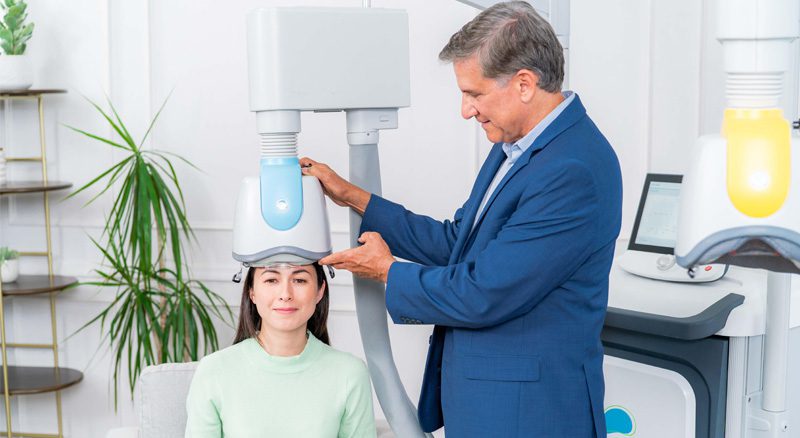
Transcranial Magnetic Stimulation (TMS) affects the Default Mode Network (DMN), Salience Network (SN), and Central Executive Network (CEN) by modulating neural activity, which helps rebalance these brain networks. Here’s how TMS interacts with each of these networks:
1. Effects on the Default Mode Network (DMN)
- Reduction in DMN Overactivity: TMS, especially when applied to the dorsolateral prefrontal cortex (DLPFC), has been shown to reduce hyperactivity in the DMN, particularly in areas like the medial prefrontal cortex and posterior cingulate cortex. This reduction in DMN activity helps alleviate excessive rumination.
- Improved Resting-State Connectivity: TMS can restore normal resting-state connectivity between the DMN and other brain areas, allowing the brain to more effectively switch out of self-referential, negative thought patterns when engaged in tasks.
2. Effects on the Salience Network (SN)
- Enhanced SN Function: TMS helps improve the function of the Salience Network, which plays a crucial role in detecting and responding to important stimuli. By increasing activity in the DLPFC and modulating the anterior insula, TMS strengthens the brain's ability to switch between internal and external focus. This improves the ability to transition from ruminating thoughts to active task engagement.
- Restoring Effective Switching: The improved functionality of the SN enhances its ability to coordinate between the DMN and CEN, helping the brain transition more smoothly between internal rest and active goal-directed behaviors.
3. Effects on the Central Executive Network (CEN)
- Activation of the CEN: TMS directly stimulates the dorsolateral prefrontal cortex (DLPFC), a key region in the CEN. This stimulation helps increase the activity and connectivity of the CEN. By improving the functionality of the CEN, TMS helps patients regain better cognitive control, decision-making abilities, and attention.
- Improved Cognitive Control: By enhancing the connectivity within the CEN, TMS helps patients better regulate their emotions and focus on tasks, which can reduce symptoms like indecisiveness and lack of concentration.
Overall Impact of TMS on Network Balance
By targeting specific areas within the CEN (e.g., the DLPFC), TMS can help to rebalance the interplay between these three networks.
Clinical Relevance
These changes in brain network dynamics are why TMS has become an effective treatment (TRD), providing relief to individuals who haven’t responded well to medication or therapy.
/assets/images/provider/photos/2757146.jpg)